The fungal cell wall is a protective structure outside the cell membrane, built mainly from glucans, chitin, and proteins. Human cells lack this structure, making the enzymes that build and maintain it attractive antifungal drug targets. Dfg5 and Dcw1 are two conserved enzymes whose roles in cell-wall construction and pathogenesis support research into a distinct treatment approach.
What the fungal cell wall is and how it works
A fungal cell wall is more than a rigid covering. It maintains cell shape, withstands mechanical and osmotic stress, and adapts as the organism grows, divides, and responds to its surroundings.
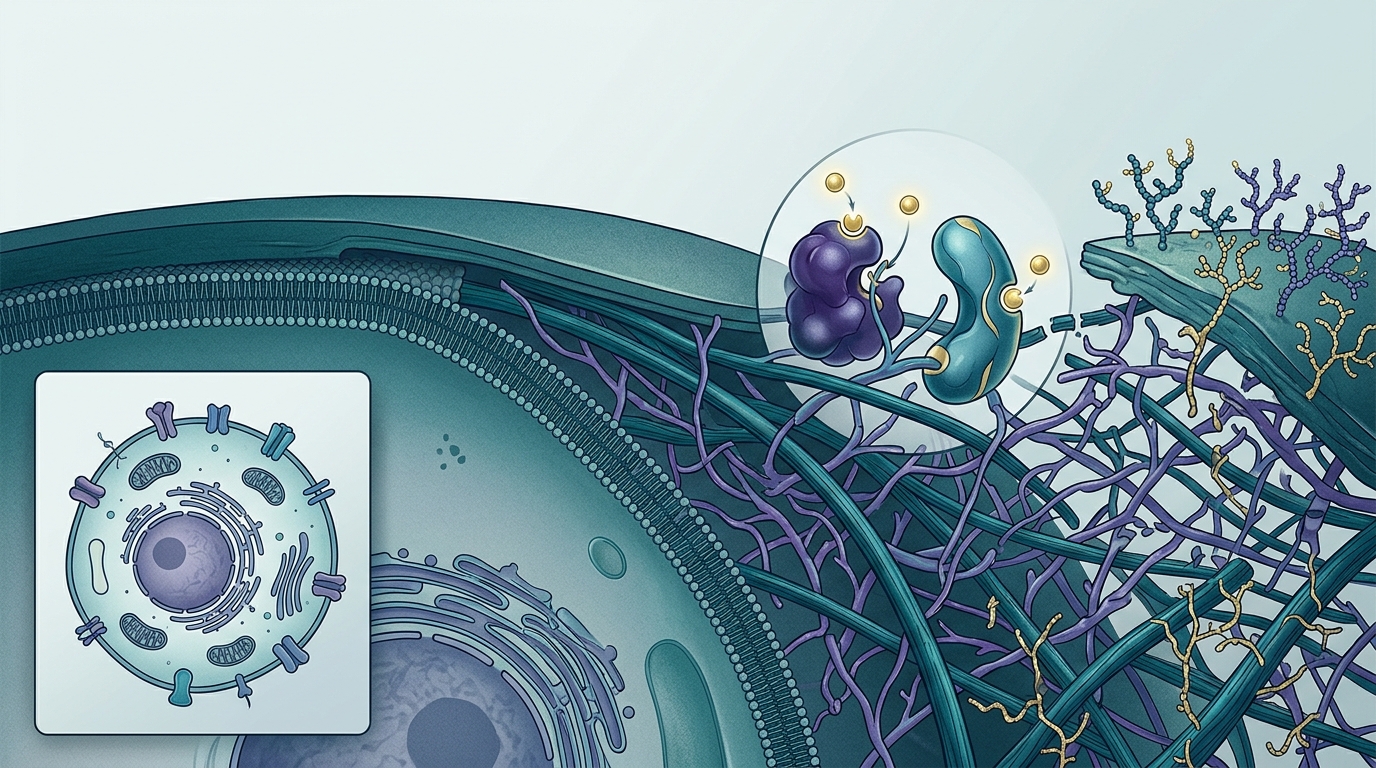
Its major components form an interconnected network. Glucans, which are chains of glucose molecules, provide much of the structural framework. Chitin adds strength, while glycoproteins—proteins with attached sugars—contribute to wall organization and interactions with the environment.
In Candida albicans, the wall also contains mannoproteins, which carry mannose-rich sugar chains. These surface components participate in processes such as adhesion and interactions with host tissues.
Building this structure requires coordinated work by multiple enzymes. Some produce the carbohydrate chains; others trim, extend, and connect them. Additional enzymes help incorporate proteins into the surrounding matrix.
This process, called fungal cell wall biogenesis, continues throughout growth. The wall must expand without losing strength, form new divisions between cells, and accommodate changes in fungal shape. Nature Index: Fungal Cell Wall Biogenesis and Function describes how synthesis and remodeling produce a durable but adaptable structure.
Human cells have membranes but no comparable cell wall. Although fungi and humans share much of their internal cellular machinery, humans do not construct this glucan–chitin framework. That difference is central to the wall’s value as a potential drug target.
An established target with underused opportunities
The fungal cell wall is not an entirely unexplored therapeutic target. Echinocandins already inhibit β-1,3-glucan synthase, an enzyme involved in producing a major wall component.
Their use demonstrates that interfering with wall construction can be clinically useful. It does not mean that all important wall-building pathways have been translated into medicines.
The wall depends on a network of enzymes that make, organize, and attach its components. Blocking carbohydrate production is one approach; interfering with protein incorporation or other remodeling processes represents a different intervention point.
This distinction matters for antifungal development. Several drugs directed at the same enzyme may share vulnerabilities, including some resistance mechanisms. Investigating additional targets can broaden the biological approaches available, although any proposed advantage must be demonstrated for the individual candidate.
The review NIH: Targeting the fungal cell wall, current therapies and implications for development of alternative antifungal agents identifies wall-associated proteins and pathways regulating wall development as opportunities for new agents. It also highlights the wall’s therapeutic appeal: it is important to fungal survival, exposed to the external environment, and absent from human cells.
“Underused” therefore describes the opportunity more accurately than “untapped.” The field has validated one important part of wall biology, but many potential targets remain subjects of research rather than established treatment.
Dfg5 and Dcw1: Enzymes that help build the wall
Our Founder, Dr. Abhiram Maddi, has done tremendous work with mutants of Dfg5 and Dcw1 in various fungi, including Neurospora crassa, Saccharomyces cerevisiae, and Candida albicans. His work has shown that mutants of Dfg5 and Dcw1 are unable to cause candidiasis in a mouse model, indicating the critical role of these proteins in disease pathogenesis. Link: https://pubmed.ncbi.nlm.nih.gov/39194851/
Dfg5 and Dcw1 are related fungal enzymes classified as α-1,6-mannosidases. Their functions are highly conserved across studied fungal species, making them relevant to broader questions about fungal growth and wall organization.
In C. albicans, these enzymes help incorporate glycoproteins into the cell wall. This work supports the connections between protein components and the carbohydrate framework, contributing to fungal cell wall integrity.
An analogy is useful: producing building materials is different from assembling them into a stable structure. Dfg5 and Dcw1 contribute to the assembly process, helping the fungus organize components into a functional wall.
The enzymes also have overlapping, or redundant, functions. When one is disrupted, the other can compensate to some extent. Genetic studies show that individual gene deletions can be tolerated in C. albicans, whereas losing both functions is lethal.
Redundancy is a form of biological resilience, but it also clarifies the research challenge. A Dfg5 Dcw1 antifungal strategy must establish how much inhibition of each enzyme is needed to disrupt the system. Activity against one target alone may not reproduce the effects of impairing both.
Conservation provides a reason to investigate these enzymes across fungal species. It does not establish that a particular inhibitor will work against every pathogen, because drug access, target dependence, and other biological differences can affect activity.
Connecting wall integrity to pathogenesis
Dfg5 and Dcw1 are relevant to more than the physical strength of the wall. Research in C. albicans connects their activity with chitin regulation, cell separation, and the development of elongated growth forms called hyphae.
In the reported experiments, mutations affecting these enzymes disrupted chitin regulation and left some cells unable to separate normally after division. Researchers also observed changes in the expression of genes that regulate hyphal development.
These findings matter to C. albicans pathogenesis because growth form and wall organization influence how the organism interacts with host tissues. In a mouse model of oral candidiasis, certain mutant strains had a reduced ability to cause disease.
The study NIH: Candida albicans Mannosidases, Dfg5 and Dcw1, Are Required for Cell Wall Integrity and Pathogenesis links these enzymes to wall construction, morphogenesis, and pathogenic behavior. It identifies them as potential antifungal drug targets.
The evidence supports further investigation, but the distinction between genetic and pharmacologic experiments is important. Altering fungal genes establishes biological relationships; it does not show that a drug can reproduce those effects at a safe dose.
Why fungus-specific biology offers a therapeutic advantage
Fungal and human cells are both eukaryotic, meaning they share many internal structures and processes. This similarity makes it difficult to identify drug targets that can be disrupted in fungi without affecting the patient.
A structure absent from human cells provides a clearer starting point for selective treatment. In principle, interfering with fungal wall construction could avoid direct effects on an equivalent human structure.
That rationale differs from proving safety. A molecule designed for a fungal target can still interact with unrelated human proteins or cause problems through its metabolism and distribution. Selectivity must be measured, not assumed.
Existing antifungal classes also help explain the distinction. Azoles inhibit ergosterol production, and polyenes bind ergosterol in fungal membranes; echinocandins inhibit glucan synthesis in the wall. Targeting Dfg5 and Dcw1 would instead focus on glycoprotein processing and incorporation.
For novel antifungal drug targets, success requires more than a compelling mechanism. A candidate must reach the infection site, engage its target, and produce useful activity at tolerable exposure. Resistance testing must also establish how fungi respond to continued drug pressure.
Where MRX-001 fits
MRX-001, MycoRx’s lead drug candidate, is designed to target Dfg5 and Dcw1. The preclinical program connects the company’s development strategy to enzymes involved in fungal cell-wall construction.
This approach focuses on a distinct intervention point rather than another version of an established membrane or glucan-synthesis target. The intended benefit is to expand the mechanisms available for antifungal development.
Published studies of Dfg5 and Dcw1 provide a biological rationale, not clinical validation of MRX-001. Evidence about the candidate’s activity, toxicity, and resistance profile must come from testing the candidate itself.
Frequently asked questions
What is the fungal cell wall made of?
The fungal cell wall is made mainly of glucans, chitin, and glycoproteins, including mannoproteins. These components form a protective network whose composition varies among species and growth conditions.
Why is the fungal cell wall a promising drug target?
The fungal cell wall supports growth and structural integrity but has no equivalent structure in human cells. This distinction creates opportunities for selective antifungal activity, although each candidate still requires safety and efficacy testing.
What do Dfg5 and Dcw1 do?
Dfg5 and Dcw1 are conserved fungal enzymes that help incorporate glycoproteins into the cell wall. In C. albicans, their overlapping functions support wall integrity and are linked to cell separation, hyphal development, and pathogenesis.
How does targeting Dfg5 and Dcw1 differ from existing antifungals?
Azoles and polyenes affect fungal membrane biology, while echinocandins inhibit β-1,3-glucan synthesis in the wall. A Dfg5- and Dcw1-directed therapy would instead target enzymes involved in glycoprotein processing and incorporation, providing a different potential mechanism.
Have Dfg5 and Dcw1 inhibitors been proven effective in patients?
The cited research supports Dfg5 and Dcw1 as potential targets through laboratory and animal studies, not clinical treatment evidence. MRX-001 remains a preclinical candidate, and its safety and effectiveness in patients would require clinical evaluation.
A different mechanism for the next stage of antifungal development
Antifungal research needs additional mechanisms to address the limitations of existing treatments. The review NIH: The Future of Antifungal Drug Therapy, Novel Compounds and Targets identifies fungus-specific proteins and pathways as important directions for developing drugs with improved properties.
The cell wall offers a clear biological foundation for that work. Dfg5 and Dcw1 illustrate how understanding the assembly process can reveal opportunities beyond established targets.
For next generation antifungal therapy, the task is to convert a credible biological target into a rigorously tested medicine. MycoRx is advancing MRX-001 through MRX-006 for pre-clinical development to advance this approach. If clinical studies establish safety and efficacy, it could provide an additional treatment option.