
Millions of people live with fungal infections that the available drugs cannot reliably treat. The four antifungal drug classes on the market share a fundamental problem: they target cell structures shared with human biology, which drives toxicity and fuels resistance.
Fungal infections have resisted treatment long enough.
MycoRx is working on
the problem from a
different angle.
Patients run out of options. Clinicians run out of tools.
Fungal infections are the world’s most
urgent health threats. In the US alone:
outpatient visits and hospitalizations annually
invasive candidiasis cases per year
average treatment cost per patient
total cost for treatment annually
WHAT WE DO
A different mechanism.
A different result.
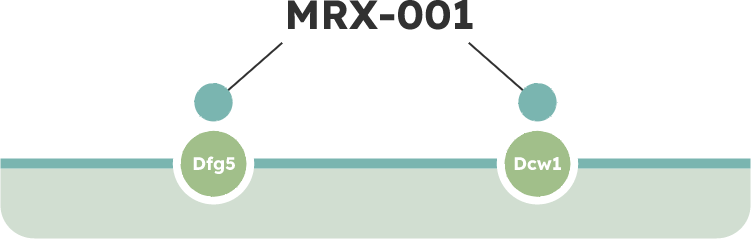
Fungal cell wall proteins — no human analog
MRX-001, our lead drug candidate, targets Dfg5 and Dcw1: two proteins found only in fungal cell walls that are essential to Candida survival. No approved antifungal drug targets these proteins. No drug currently in development does, either.
MRX-001 demonstrates lethal activity against Candida albicans and multidrug-resistant Candida auris. Compounds MRX-001 to MRX-006 also show antifungal efficacy against drug-resistant strains of both species.
This is what first-in-class means in practice: not a variation on what already exists, but a compound built on a target the field has not touched.

Polyenes

Azoles

Allylamines

Echinocandins
THE PROBLEM WE SOLVE
The problem with
existing antifungals.
There are four antifungal drug classes available today: azoles, echinocandins, polyenes, and allylamines. All of them target structures inside the cell that closely resemble human cell structures. That overlap is why they carry significant toxicity burdens. It is also why fungi have learned to resist them.
For patients who are immunocompromised, elderly, very young, or have already exhausted their options, this is not an abstract problem. It is the end of the road.
MycoRx started with a different question: what if you targeted something fungal cells need that human cells do not have?
WHY MYCORX?
Built from a question
nobody else was asking.
Founded in 2020 on the strength of a 2019 lab discovery, MycoRx was built by scientists who had spent years studying how fungal cells survive in a host. That research led to the identification of Dfg5 and Dcw1 as critical proteins in fungal cell wall biogenesis and, from there, to the development of a molecule capable of blocking them.
No other pharmaceutical developer had targeted these proteins. Getting there required the kind of deep scientific curiosity that produces genuinely new approaches rather than incremental ones.
The scientists behind MycoRx have deep roots in fungal cell biology and clinical research. They bring an expertise to this problem that only comes from spending years inside it.
We are an early-stage company with initial angel funding secured and an IND filing with the FDA on track for 2027. The science is real. The timeline is clear. The need is urgent.
Advanced science.
Disciplined execution.
MycoRx is developing a drug that fungal disease has never faced before. We are doing it rigorously, transparently, and with the patients who need it most in mind.
Discovery-driven. Disruptive by design. Built for access.
FAQs
Common questions about fungal infections, antifungal drug development, and why a new approach is needed.
Why are fungal infections so difficult to treat?
Fungal cells are more similar to human cells than bacterial cells are. That biological overlap means drugs that attack fungi often also affect human tissue, leading to significant toxicity. It also means that the mechanisms fungi use to develop drug resistance are difficult to block without also disrupting human biology. The result is a class of drugs that are hard to tolerate and increasingly easy for fungi to resist.
What is a first-in-class antifungal drug?
A first-in-class drug uses a mechanism of action that no approved drug uses. For antifungals, that means targeting a biological structure or pathway that existing drug classes have never touched. MRX-001 is first-in-class because it targets fungal cell wall proteins, specifically Dfg5 and Dcw1, that no approved antifungal drug or drug currently in development targets. It is not a new formulation of an existing approach. It is a genuinely new approach.
Why has antifungal drug development stalled?
Most antifungal drug development has iterated on the same four mechanisms for decades: azoles, echinocandins, polyenes, and allylamines. All four target structures inside fungal cells that overlap with human cell structures, which creates an inherent ceiling on how safe and how effective they can be. Few developers have pursued fundamentally different targets, in part because identifying viable new targets requires deep basic science research into fungal cell biology. That is where MRX-001 came from.
How large is the antifungal drug market?
The addressable market for an effective antifungal drug is estimated at $13 billion. Candida infections alone account for approximately 138,000 cases annually in the U.S., with mortality rates between 30 and 40 percent. Fungal disease is a global health problem that affects millions of people each year, from immunocompromised patients to otherwise healthy individuals with recurrent infections. It is a large, underserved market with no new mechanism of action in decades.
What is Candida and why does it matter?
Candida albicans is the most prevalent infectious fungus and the primary cause of serious systemic fungal infections in humans. It can cause everything from recurrent mucosal infections to life-threatening systemic candidiasis, particularly in patients with compromised immune systems. It is also the fungal pathogen most affected by drug resistance, as existing antifungal drugs have become less effective over time. MRX-001 has demonstrated lethal efficacy against Candida albicans in preclinical studies.
Where is MycoRx in its development timeline?
MycoRx is completing preclinical efficacy and safety studies on MRX-001 and is on track to file an Investigative New Drug (IND) application with the FDA by the end of 2027. Initial angel funding is secured. Subject to IND acceptance, clinical trials would follow. We are actively seeking investment partners and pharmaceutical collaborators to support the next phase of development.

Didn’t find the answer?
WHY MYCORX?
Ready to learn more?
Whether you are an investor, a clinical partner, or a researcher working in adjacent spaces, we want to talk.