Milestone 1
Q1 2019


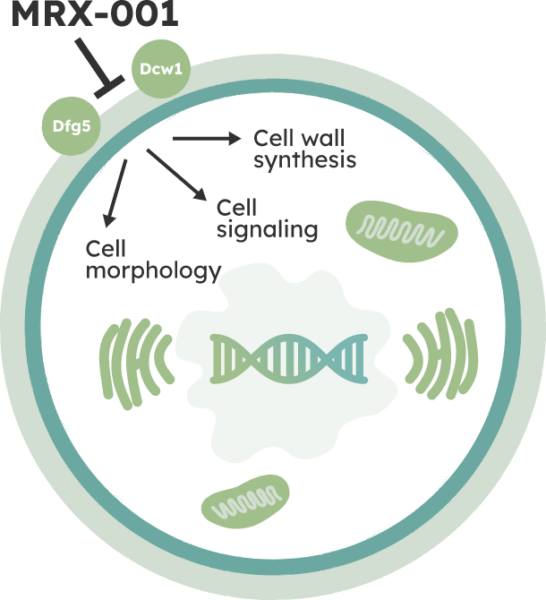
MRX-001 targets Dfg5 and Dcw1, two proteins found only in fungal cell walls; no other drug in existence or under development targets this unique structure. These proteins are instrumental in maintaining fungal cell walls—blocking their action disrupts cell morphology, signaling and cell wall synthesis, making MRX-001 lethal to fungal cells and only fungal cells.
MRX-001 to MRX-005 have similar chemical structure and represent our pipeline of drugs targeting Dfg5 and Dcw1. US and Canadian patents were issued for MRX-001 in July 2026, indicating the strength of our IP strategy.
WIDE RANGE OF USES

VETERINARY

MEDICAL
DEVICE

DENTAL
Because MRX-001 targets cell walls unique to Candida and other fungi, it promises a wide therapeutic range. While its primary target is invasive Candidiasis, it also has potential to treat other fungal infections of the skin and oral cavity.
Invasive Candidiasis is a life-threatening systemic infection that can affect the bloodstream, heart, brain, eyes, and bones. It is most dangerous for patients with compromised immune systems, including those undergoing chemotherapy, transplant recipients, ICU patients, and individuals with HIV/AIDS. Unlike the secondary targets, invasive Candidiasis is not a single localized condition. It is the most serious manifestation of fungal disease and the clearest case for why a new treatment mechanism is needed.
MRX-001 originated from a 2019 discovery: that blocking specific fungal cell wall enzymes could prove lethal to Candida while leaving human cells unaffected. Since MycoRx was established, patent applications were filed, and early-round funding was secured. We expect completion of preclinical studies and IND filing by year-end 2026.
Q1 2019
Q2 2019

Q3–Q4 2019

Q2 2020

Q3–Q4 2020

Q4 2020

Q2–Q3 2021

Q2 2026

Q3 2026

Q3-Q4 2026

Q1 2027

Q2-Q3 2027

No new class of antifungal drug has reached patients in over two decades — until now. Here’s what you need to know about MRX-001.
MRX-001 is MycoRx’s lead antifungal drug candidate. It works by blocking Dfg5 and Dcw1, two proteins found only in fungal cell walls that are essential to Candida survival. By targeting these proteins, MRX-001 disrupts fungal cell wall construction and integrity, making it lethal to fungal cells while leaving human cells unaffected. No approved antifungal drug and no drug currently in development uses this mechanism.
MRX-001’s primary target is invasive candidiasis, a life-threatening systemic infection most common in immunocompromised patients. Because it targets the fungal cell wall broadly, it also shows potential against other Candida-related infections including oral thrush, vaginal thrush, denture stomatitis, diaper rash, and athlete’s foot. The mechanism also suggests broader applicability across fungal pathogens beyond Candida.
The four existing antifungal drug classes all target structures inside the cell that closely resemble human cell structures. That overlap is why they cause significant side effects. MRX-001 targets proteins that have no equivalent in human biology, which is why early preclinical data shows a significantly lower toxicity profile. The target is fungal. The damage is fungal.
Drug resistance develops when fungi evolve to protect or bypass a drug’s target. Because MRX-001 targets proteins that are essential to fungal survival and structurally unique to fungi, the pathways for resistance are more limited than with existing drug classes. Preclinical studies have shown low resistance development against MRX-001.
MRX-001 is being developed for both oral and intravenous delivery. The oral formulation is a priority because it would expand access significantly, allowing treatment outside of hospital and clinical settings. Delivery formulation work is part of the ongoing preclinical program.
Following a successful IND filing and FDA acceptance, MycoRx would advance MRX-001 into Phase 1 clinical trials to assess safety and dosing in humans. Phase 2 and Phase 3 trials evaluating efficacy across patient populations would follow. The company is actively seeking investment partners and pharmaceutical collaborators to support this next phase of development.
Because MRX-001 targets proteins in the fungal cell wall rather than structures specific to a single pathogen, the mechanism has potential applicability across a broader range of fungal diseases. Initial development is focused on Candida, where the unmet need is clearest and the preclinical data is strongest. But the same cell wall biology exists in other clinically significant fungi, and MycoRx sees MRX-001 as the foundation of a broader antifungal platform. As clinical development progresses, the company intends to explore additional indications, formulations, and populations where the mechanism could deliver the same advantages: targeted efficacy, lower toxicity, and reduced resistance. That includes both expanded human indications and veterinary applications, where fungal infections present many of the same resistance and toxicity challenges.

Didn’t find the answer?